

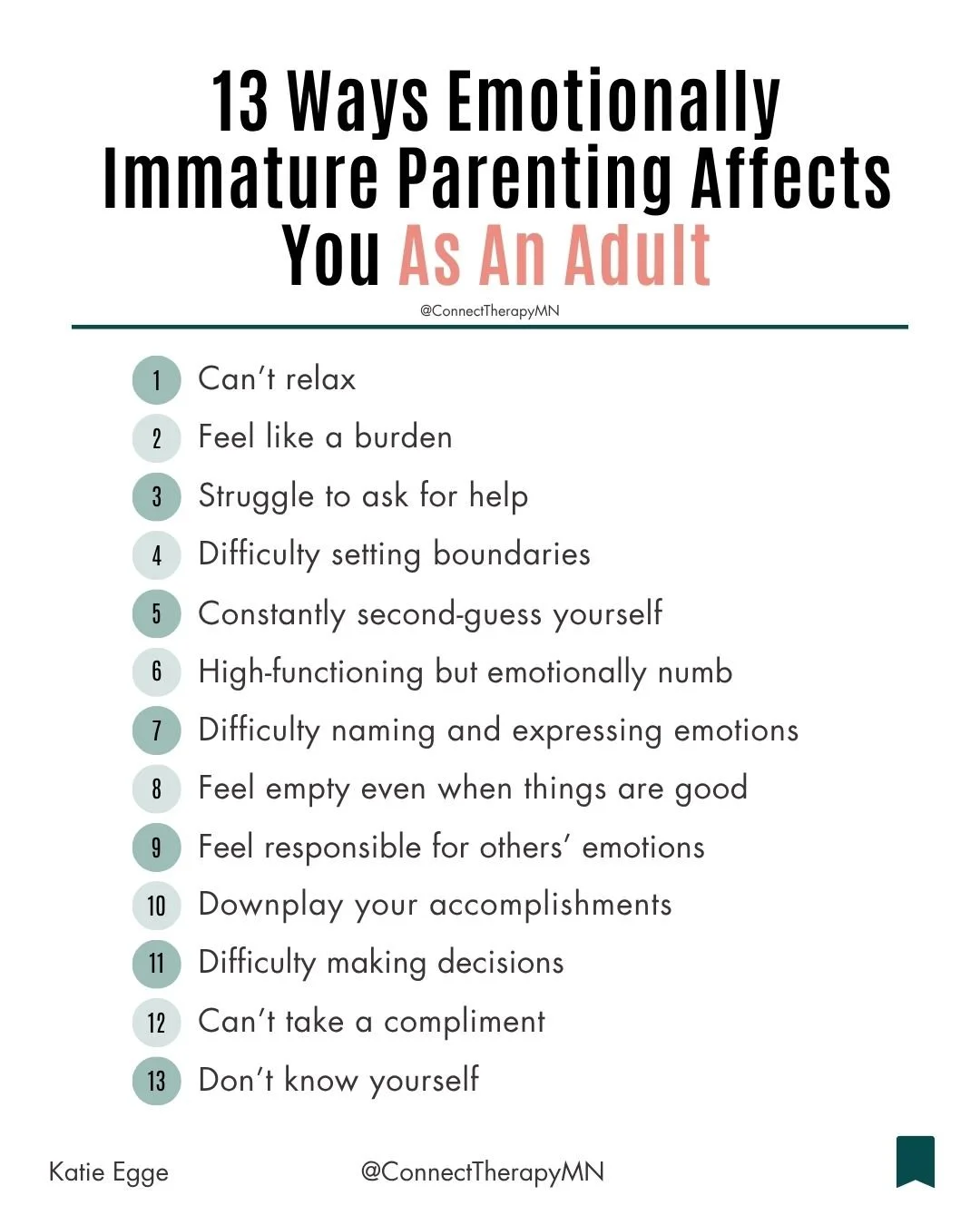
13 Ways Emotionally Immature Parenting Affects You As An Adult

Many adults don’t realize their struggles started in childhood
What first brings many of my clients into my therapy office isn’t their past…
It’s what’s happening right now:
Feeling stressed out by their parents - but unable to set a boundary that sticks
Struggling to connect and feel heard in their marriage
Feeling overwhelmed and like they’re failing as a partner and/or parent
Struggling to identify what they’re feeling - or even need
But these struggles usually start in childhood - yes, even in homes that looked “good” on the outside and had loving parents.
Because parenting isn’t just about providing for your physical needs.
It’s also about being able to:
Handle emotions (your own + your child’s)
Show empathy
Repair and take accountability after conflict
Support a child’s inner world
Meet a child’s emotional needs
And this requires emotional maturity.
If your parent lacks this, you learn to adapt. Automatically. Without even realizing it.
And these adaptations don’t just disappear the moment you become an adult. They follow you into adulthood - shaping how you think, feel, relate, and live.
So if certain patterns keep showing up in your life, this may be why.
What an Emotionally Immature Parent Actually Looks Like
An emotionally immature parent (EIP) struggles to regulate their emotions, empathize, and respond consistently to their child’s emotional needs.
They often:
React instead of respond
Ignore, dismiss, or ridicule feelings
Defend or attack when confronted
Make everything about themself versus be curious about your inner world
Most EIPs love their kids…
But here’s the reality: love alone doesn’t meet a child’s emotional needs.
And not getting your emotional needs met has lasting - and oftentimes crippling - consequences.

13 Ways Having An Emotionally Immature Parent Affects You As An Adult
1. You can’t relax
If you grew up walking on eggshells, your nervous system didn’t learn how to relax.
So now you may:
Feel guilty for resting
Feel tense for no clear reason
Scan rooms, footsteps, and tone for signs of unsafety
Your body still acts like something’s about to happen - even when it isn’t.
2. You feel like a burden
If your emotions were dismissed, ignored, or treated like a problem growing up, you probably learned one thing fast:
Don’t need too much.
Now you may:
Apologize constantly
Hesitate to open up
Feel guilty when people help you
You didn’t become “low maintenance” or “the easy-going one” by choice. You learned to take up less space to survive.
3. You struggle to ask for help
If support wasn’t reliable or came with strings growing up, you stopped expecting it.
So now you:
Handle everything alone
Struggle with vulnerability
Feel uncomfortable being taken care of
Even when help is available, it doesn’t feel natural - it feels like you’ve failed.
4. You have difficulty setting boundaries
If saying “no” to your parent growing up led to guilt, anger, or withdrawal, your brain learned that boundaries = danger.
So now you:
Overexplain and overfunction
Feel responsible for others’ reactions and problems
Say “yes” when you mean “no” - and later regret it
You don’t lack boundaries - you were trained to ignore them.
5. You second-guess yourself constantly
If your thoughts or feelings were ignored, minimized, or punished growing up, trusting yourself doesn’t come easily now.
Instead you may:
Overthink small decisions and look to others to decide for you
Ask for reassurance constantly
Worry you’re overreacting
You weren’t born unsure. You were taught not to trust yourself.
6. You look fine on the outside - but feel emotionally numb inside
Many adult children of EIPs are high-functioning: responsible, reliable, successful…and emotionally flat.
You might:
Struggle to feel joy (referred to as ‘foreboding joy’)
Feel disconnected from yourself - and others
Move through life on autopilot
Numbness isn’t a design flaw. It was one of your primary survival strategies.
7. You struggle to name and express your feelings
Children learn emotional intelligence through emotionally attuned caregivers.
that guidance is missing, you may grow up feeling disconnected from your feelings - and yourself.
You may:
Struggle to identify, express, and cope with your emotions
Default to “I’m fine” or “good” - even when you’re not
Feel overwhelmed by your own and others’ emotions
The good news: emotional awareness is a skill - and it can be learned at ANY age.
8. You feel empty - even when things are good
Surviving an emotionally immature parent (EIP) often requires disconnecting from your own emotions. So you learn to detach. But that doesn’t just turn off the hard feelings - it dulls the good ones, too.
As a result, it can be hard to fully enjoy things or feel happy, even when life is going well.
Instead, you may:
Feel a sense of foreboding joy - like something bad is about to happen
Struggle to trust good moments or let them fully land
Hold yourself back from getting too excited
Feel emotionally flat or disconnected, even in meaningful moments
Because growing up, good feelings didn’t always feel safe, consistent, or lasting.
9. You feel responsible for everyone else’s emotions
If your parent relied on you for emotional support, you may have learned early that it was your job to keep others happy.
You might:
Feel guilty when someone is upset - even when it’s not your fault
Put others’ needs - including their struggles - before your own
Only feel OK if others are OK
Over time, this emotional caretaking can become exhausting as you never get your needs met.
10. You downplay your accomplishments
If your achievements were minimized, ignored, or seen as a threat to your parent’s ego growing up, celebrating yourself may feel uncomfortable now.
You might:
Dismiss compliments and praise
Attribute success to luck
Struggle to celebrate milestones (e.g. birthdays) and achievements (e.g. promotions)
Instead of owning your wins, you may instinctively shrink them - and uncomfortable being celebrated by others
11. You’re indecisive
If your choices were criticized, ridiculed, or overridden growing up, decision-making may still feel stressful.
You may:
Overanalyze options
Worry about making the wrong choice
Delay or avoid decisions altogether
Underneath this is often a lack of trust in yourself - which stems from not really knowing yourself.
12. You struggle to take a compliment
When you grew up with an emotionally immature parent, you likely didn’t receive consistent, genuine acknowledgement, validation or praise. Rather you experienced negging, or backhanded compliments, or nothing but criticism. So now, when someone says something kind about you, it doesn’t quite land.
You might:
Brush it off or change the subject
Minimize what you did
Feel uncomfortable or exposed
Assume they don’t really mean it
It’s not that you don’t want to believe it. It’s that a part of you never learned how.
When your worth wasn’t consistently reflected back to you growing up, it can feel unfamiliar - even unsafe - to fully take it in now.
13. Your coping mechanisms run your life
If you grew up with an EIP, coping mechanisms weren’t optional - they were necessary.
You might have learned to cope by:
People-pleasing
Avoiding conflict
Overthinking everything
Staying busy to avoid feelings
Shutting down when emotions are high
But now these very survival strategies may be keeping you stuck in life and making decisions for you, instead of the other way around.
13. You feel like you don’t know yourself
When childhood revolves around anticipating and managing a parent’s reactions, there’s often little space - or energy - left to explore your identity. Many EIPs don’t encourage you to figure out who you are. So many children learn to gravitate toward their parent’s interests just to get attention, approval, or connection
You may wonder:
What do I actually want?
What do I enjoy?
Who am I outside of my job or helping others?
Reconnecting with yourself can feel unfamiliar - but it’s possible and necessary in order to heal and move on from your childhood…and your parent.
If you recognized yourself in several of these signs, there’s nothing wrong with you.
These patterns didn’t come out of nowhere. You were shaped by what you had to adapt to in order to get through childhood with a parent who couldn’t meet your emotional needs sufficiently enough. Even if they met your physical needs - food, clothes, education, and shelter - Childhood Emotional Neglect (CEN) can still happen…and leave lasting affects.
And while those adaptations may have helped you survive childhood, they can make adulthood feel harder than it needs to be - negatively impacting your relationships, career, life choices, and self-confidence.
But the important thing to keep in mind is that these patterns aren’t permanent.
With awareness and support, you can learn how to:
Know, trust - and love - yourself
Set boundaries that actually stick
Understand and cope with emotions
Stop over-function for everyone else
Feel more steady and connected in your life and with others
Healing doesn’t require blaming your parents. But it does require understanding how their limitations affected - and still affect - you. And that’s where real change begins.
Want support to heal from your emotionally immature parent? Start Here
If this resonated with you, the next step isn’t working harder - it’s about working differently by getting to the ROOT of your struggles.
That means understanding where these patterns came from, how they shaped you, and what it looks like to respond differently now - in a way that you’ve always needed growing up, but didn’t get.
This is the work I help clients do every day - whether that’s through therapy, coaching, or my 2 support groups:
Not sure where to start? No problem! Click the link below and we can figure out a plan forward together:
About the Author
Katie Egge, LMFT is a Licensed Marriage and Family Therapist and founder of Connect Therapy MN. She specializes in helping adults heal from childhood emotional neglect and emotionally immature parents through virtual therapy, coaching, and Support Groups. Using Internal Family Systems (IFS), Emotionally Focused Therapy (EFT), and attachment-based approaches, Katie helps clients break free from survival patterns, build healthier relationships, and reconnect with themselves.
Learn more about Katie → About Katie
Explore the Online Support Groups:
Not sure where to start? BOOK A FREE CONSULTand Katie can help you determine the best path forward. You don’t have to figure this out alone.