

15 Signs You Grew Up With Emotionally Immature Parents (Even If Your Childhood Seemed Normal)

Summary: If you've always felt unseen, overly responsible, or like you had to earn love and approval, you may have been raised by an emotionally immature parent. In this article, you'll learn 15 common signs of emotionally immature parenting, how these patterns affect you in adulthood, and why healing starts with understanding that your struggles are adaptations—not flaws.
Was your childhood really as “good” as you thought?
For many adult children, the realization that their parent may be emotionally immature can feel both clarifying - and heartbreaking.
From the outside, your childhood may have looked perfectly normal:
Food on the table
Roof over your head
Yearly family vacations
Parents who were physically present
But on the inside, it may have felt:
Lonely
Confusing
Unpredictable
As we get older, it’s common to to start reflecting on our relationship with our parents, and notice patterns that have likely always been there - but weren’t noticeable until now:
Conflicts getting swept under the rug instead of resolved
Differences in opinions, wants, and needs being seen as “a problem”
Leaving conversations feeling unseen, unheard, and misunderstood
Walking on eggshells around their parent
Surface level conversations - or a one-sided relationship where you’re the one doing the work to keep it alive

Recognizing these patterns can make your relationship with your parent feel more confusing and complicated.
Having anything other than love and gratitude toward them can trigger guilt, shame - or a sense that you’re betraying them.
It’s easy to tell yourself:
“Maybe I’m being too sensitive.”
“Other people had it way worse.”
“My parents did the best they could.”
But viewing your parent from the lens of emotional immaturity can be a game changer, helping you move forward from confusion and guilt - to understanding and clarity.
15 Signs Your Parent is Emotionally Immature
While there’s no official diagnosis for emotional immaturity, there are definite characteristics that exist:
1. They are reactive and unpredictable
Emotionally immature parents (EIPs) often react from emotion rather than responding thoughtfully, which threatens safety.
Their reactions often feel intense, unpredictable, or out of proportion, leaving you feeling on edge and constantly walking on eggshells around them.
Adults raised by this type of parent often stay on high-alert, constantly scanning the room for tone, footsteps, facial expression, and have increased struggles with anxiety, boundaries, and confidence.
2. They minimize, ignore, or punish your feelings and experiences
When you expressed hurt, anger, sadness - or even excitement - it was often invalidated.
You may have heard things like:
“You’re fine.”/”It’s not a big deal!”
“You’re so sensitive/dramatic!”
“That never happened!”
“Go to your room!”
Over time, this teaches children that their emotions are wrong, inconvenient, or too much.
Many adults raised this way struggle to feel, trust and communicate their own feelings and reality.
3. They expect you to be their emotional caretaker
From a young age, you learned that your parent’s mood could change the entire household, and may have adapted by:
• Keeping the peace
• Hiding your feelings
• Trying to “fix” or “prevent” their emotions
As an adult, this often shows up as people-pleasing and feeling responsible for others’ emotions.
4. They rarely apologize or take accountability
When conflicts happened, your parent often avoided responsibility. Apologies were rare - or nonexistent.
Instead, you may have experienced:
• Denial (sweeping things under the rug)
• Blame shifting
• Guilt-tripping
This can leave you feeling confused, anxious, and responsible for problems that aren’t yours.
5. They struggle to consider your perspective
Your thoughts, feelings, and experiences were often dismissed or misunderstood.
EIPs often struggle to see things from anyone else’s point of view but their own.
This can leave adult children feeling unheard, unseen, and misunderstood.
6. They lack empathy and compassion
Even when you were clearly hurting, your parent may have responded with:
• Teasing
• Criticism
• Indifference
Instead of compassion or comfort. This can make adults hesitant to be vulnerable in relationships.
7. Put their wants and needs before yours
Your needs were often treated as inconvenient, dramatic, or selfish. So you learned to minimize yourself in order to keep the peace.
As adults, many people raised this way struggle to identify and prioritize their own needs without guilt.
8. They confuse connection with control
Many EIPs equate closeness with obedience or compliance with their expectations and wishes. Silent treatment was a normal '“consequence” when you acted out of line as love, attention, and approval were often conditional.
This can make adult relationships feel confusing, transactional, or emotionally unsafe.
9. They see your boundaries as rejection
When you try to set boundaries, EIPs often interpret it as:
• Disrespect
• Rejection
• Betrayal
This makes boundary-setting feel incredibly difficult and guilt-inducing for adult children.
10. They can’t tolerate differences
EIPs often expect their child to think, feel, believe, or behave the same way they do. Individuality is often feared and met with criticism, mocking, or punishment.
As a result, many children learn to suppress parts of themselves to avoid conflict.
11. Mistakes are shamed
Growing up with an EIP often means that making a mistake wasn’t treated as a learning opportunity - it was treated as a personal failure.
Instead of guidance or encouragement, you were met with criticism, ridicule, or punishment.
12. They make everything about themself
EIPs tend to focus primarily on their own thoughts, needs, and experiences.
Conversations often revolve around them:
Your decision to move away for college? How could you leave them all alone!
Your baby shower? It’s all about how they’re going to be grandparents.
Children in these environments often grow up believing they are less important, and struggle to honor their wants and needs.
13. They avoid hard conversations
EIPs often steer clear of any topic that makes them feel uncomfortable. Whether it’s conflict, feelings, puberty, relationships, or misunderstandings, these conversations are seen as threatening.
As a result, problems are often swept under the rug, denied, or ignored. Children learn that expressing needs, asking questions, or addressing challenges may provoke tension or rejection.
As adults, you might notice yourself struggling to have honest conversations, fearing conflict, or feeling frustrated when others avoid addressing important issues.
14. They are oblivious to their own - and other’s - emotional needs
EIPs often seem unaware of their own feelings and needs - and even less aware of yours.
They often have no idea what they actually want or need, and expect you to read their mind and just know without them saying anything. In addition, they tend to ignore emotional cues, dismiss feelings, or expect you to “figure it out” on your own.
As an adult, this can leave you feeling unseen, confused, or frustrated in relationships, and unsure how to identify and express your own needs without guilt.
15. They fail to show interest in knowing you
For many adult children of EIPs, there was a persistent sense of being invisible.
EIPs oftentimes skip the follow-up questions regarding your thoughts, feelings, or experiences. Milestones, achievements, and even your passions could go unnoticed or uncelebrated.
This can leave children feeling unimportant, a pattern that often carries into adulthood.
Many adults still crave validation, struggle with self-worth, or find it difficult to believe that people truly like - and care - about them.
Recognizing the signs of an Emotionally Immature Parent can be life-changing
For many adults, learning about emotionally immature parents brings a lot of clarity as things suddenly start to make sense:
Why relationships feel exhausting
Why boundaries are so hard
Why guilt shows up whenever you try to prioritize yourself
Recognizing these signs in your parent doesn’t mean they’re bad people, you’re a bad kid, or that you hate your parent.
It means your nervous system is waking up.
You’re becoming aware of what happened to you growing up - and more importantly - what didn’t happen but should have.
And this awareness is what opens the door to real healing.
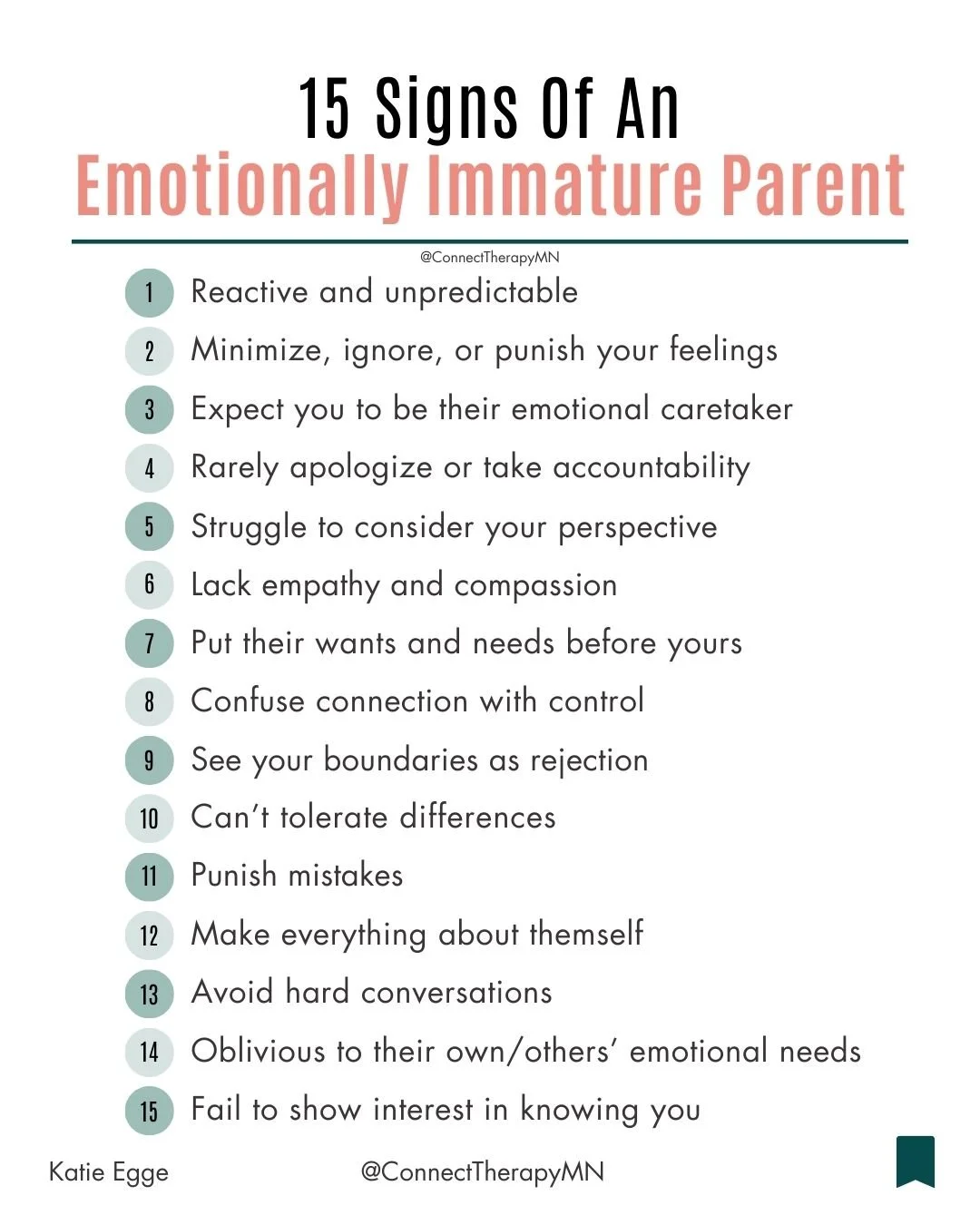
Next Steps: Healing From Your Emotionally Immature Parent
Many adults with “normal” childhoods experience these same struggles. Recognizing the patterns is empowering - it gives you the clarity to begin breaking cycles of emotional neglect.
If you’re ready to take that next step toward healing, my 8-week virtual Support Group for Adult Children of Emotionally Immature Parents is a safe space to:
Understand and process your family’s patterns
Identify your feelings and needs
Manage your triggers - so they stop controlling your life
Learn practical tools to set boundaries and stay steady - no matter what your parent does
You don’t have to put your life on hold waiting for your parent to change before moving forward.
“Naming what happened to you isn’t blaming your parent - it’s reclaiming your story.”
About the Author
Katie Egge, LMFT is a Licensed Marriage and Family Therapist and founder of Connect Therapy MN. She specializes in helping adults heal from childhood emotional neglect and emotionally immature parents through virtual therapy, coaching, and Support Groups. Using Internal Family Systems (IFS), Emotionally Focused Therapy (EFT), and attachment-based approaches, Katie helps clients break free from survival patterns, build healthier relationships, and reconnect with themselves.
Learn more about Katie → About Katie
Explore the Online Support Groups:
Not sure where to start? BOOK A FREE CONSULTand Katie can help you determine the best path forward. You don’t have to figure this out alone.